As CIA Ramps Up Covert Ops Against Cuba, Archive Posts Declassified Documents on Precedent-Setting Project AMTRUNK
Declassified CIA Reports Chronicle Failed Covert Effort to “Split the Regime”
Clandestine Coup Plan Came from New York Times Reporter
As CIA Ramps Up Covert Ops Against Cuba, Archive Posts Declassified Documents on Precedent-Setting Project AMTRUNK
Declassified CIA Reports Chronicle Failed Covert Effort to “Split the Regime”
Clandestine Coup Plan Came from New York Times Reporter
Washington D.C., November 17, 2026 - In a Top Secret proposal to the CIA director, a high-ranking Directorate of Operations official recommended a “pincers strategy” to bring down the Cuban government, according to declassified operational records published today by the National Security Archive. The March 1963 proposal called for combining “economic strangulation to weaken and undermine the regime…with an intensive probing effort to identify and establish channels of communication to disaffected and potentially dissident non-Communist elements in the power centers of the regime.”
Codenamed “AMTRUNK,” the mission objective was “to overthrow the existing Cuban government by means of a conspiracy among high level military and civilian leaders of the government culminating in a coup d’etat which will oust both Castro and the Communists from power,” according to another formerly secret CIA report posted today. A special CIA task force ran the operation for almost three years before concluding that virtually all of the Cuban assets they had recruited to “split the regime” were, in fact, “controlled or monitored” by the Cuban intelligence service, the DSE.
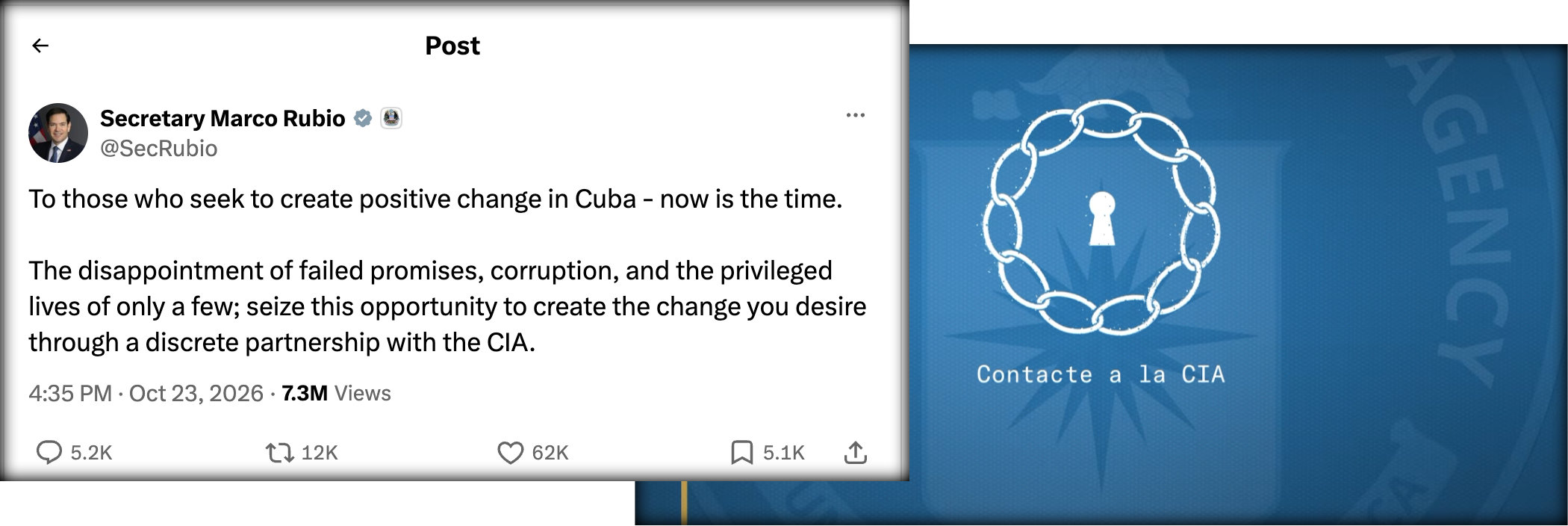
AMTRUNK bears an uncanny resemblance to the Trump administration’s current covert efforts to overthrow the Cuban government. In a clear threat to escalate regime-change operations, on November 12, President Trump declared that “I want to get Cuba done before I leave [office].” In addition to escalating economic warfare against the island, the CIA has reportedly established another special task force with the mission to sow division among Cuba’s military and civilian leaders—creating destabilizing conditions conducive to an internal coup. In a late October post on X, Secretary of State Marco Rubio openly called on Cubans to “form a discreet partnership with the CIA.” The Agency then posted a recruitment video with instructions on how to securely contact the CIA. “We are anxious to work with you,” the 1 minute and 53 second guide concludes.
The open call to join the CIA’s assault on the Cuban government, according to the Archive’s Cuba analyst Peter Kornbluh, is designed to foster internal distrust and suspicion, eroding the cohesiveness of the Cuban leadership. “The CIA has dusted off its old playbook of trying to split the regime,” he noted. “But the documented history of Operation AMTRUNK remains a cautionary tale of failure.”
The AMTRUNK operation became one of the CIA’s first major covert initiatives in the wake of the Cuban Missile Crisis. The public resolution of the crisis involved a U.S. pledge of no future invasions of Cuba if the Soviets permanently withdrew their missiles from the island. White House and CIA officials remained obsessed with overthrowing Castro, but the Kennedy-Khrushchev agreement on the missile crisis forced the CIA to revisit its Operation Mongoose strategy to foment an uprising in Cuba that would trigger massive U.S. military intervention. “A mass popular uprising is neither likely to occur nor should it be encouraged under present circumstances,” the head of the CIA’s task force on Cuba, Desmond Fitzerald, wrote in his March 1963 proposal on AMTRUNK. “Current policy excludes the overt use of U.S. military force to overthrow the Castro/Communist regime.” Instead, Fitzgerald proposed a program to “exacerbate and stimulate disaffection in the Cuban armed forces.”
But the idea to target dissident military officers to foment an internal uprising did not originate with the CIA; it was brought to the Agency by an unlikely source: the leading New York Times correspondent for Cuba, Tad Szulc. In early February 1963, Szulc, along with USIA officer George Volsky and a Cuban exile named Nestor Moreno, drafted a six-page “plan of action” to “establish contact with elements within the Government, Rebel Army, and Militia,” and press them “to act now” to generate internal upheaval. Designated “Operation Leonardo,” Szulc presented the plan to a special coordinating committee on Cuba in the State Department on February 5, 1963.
State Department officials immediately referred Szulc to the CIA, and an officer met with him at his home in Washington, D.C., the very next evening. According to a secret summary of the meeting, Szulc (CIA code-name AMCAPE-1) had planned to present the plan to President John F. Kennedy (codenamed GPIDEAL) or Attorney General Robert Kennedy. “AMCAPE-1 is of the firm belief that the concept envisaged by the LEONARDO PLAN is the one sure way of splitting the regime and that the time is NOW,” the summary stated. A high-level group of CIA officials met with Szulc and Volsky three days later to identify potential military assets and how to contact them. By April, the operation, officially code-named AMTRUNK, was planning approaches and infiltrations to recruit dissident Cuban military officers who could depose Castro.
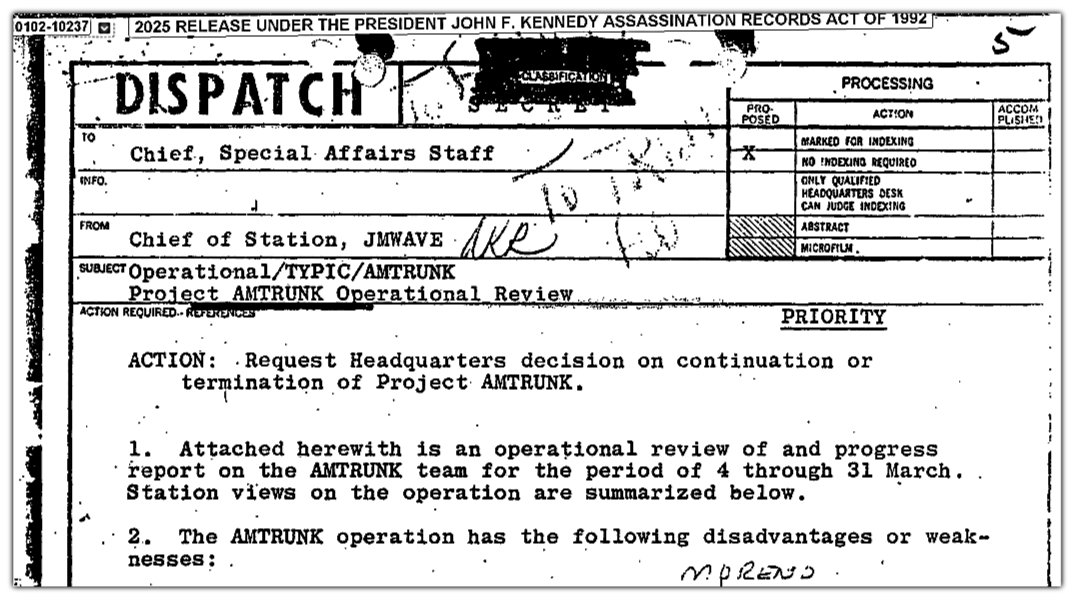
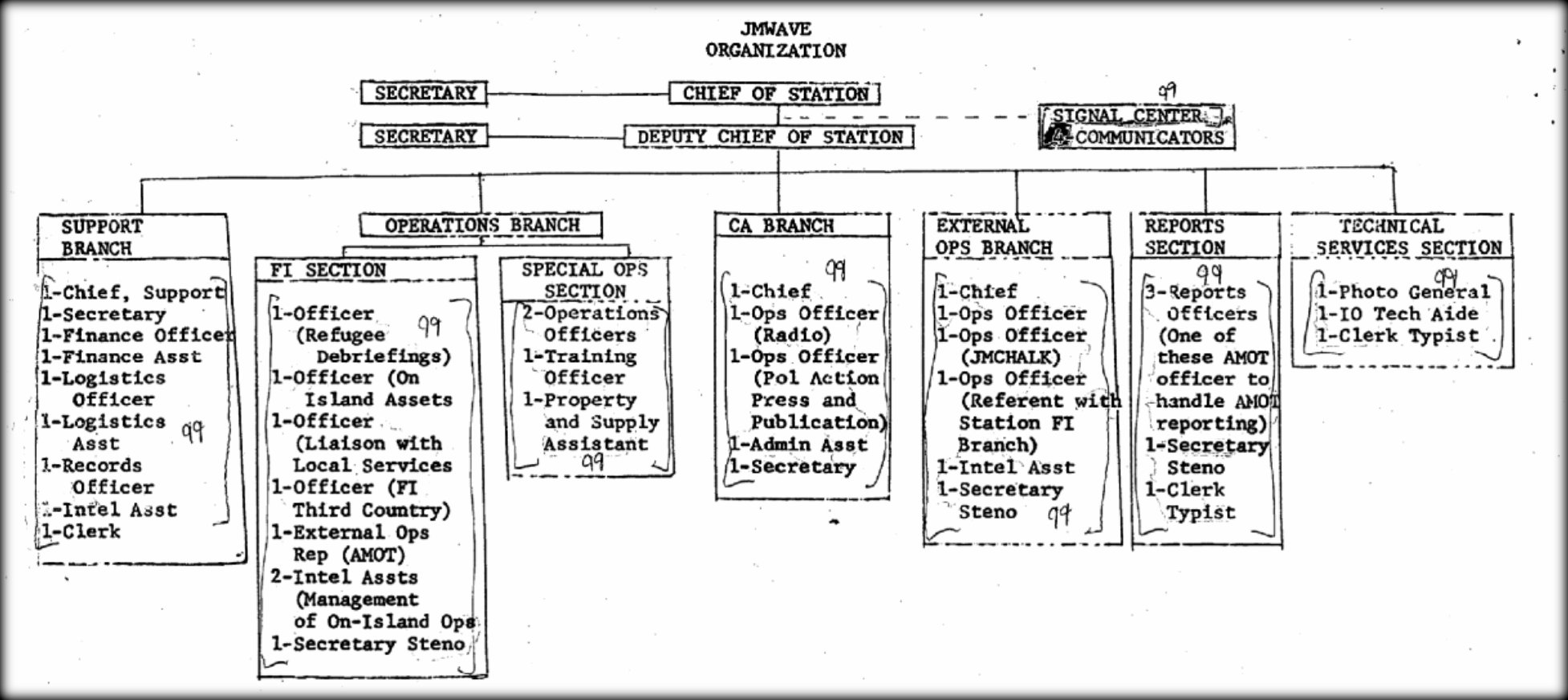
Given its origins, CIA officials had major reservations about the wisdom of AMTRUNK. In his first operational review, Theodore “Ted” Shackley, the chief of the CIA’s Miami station, JMWAVE, recommended “that this operation be terminated at the earliest possible moment.” Shackley predicted trouble for the Agency: “this operation has a very high ‘flap potential’ if any AMTRUNK agents are picked up by the opposition in Cuba.” The CIA would “stand to suffer” if the operation was exposed, he warned, especially since AMTRUNK was linked to Szulc and the New York Times, which “could prove to be most embarrassing.”
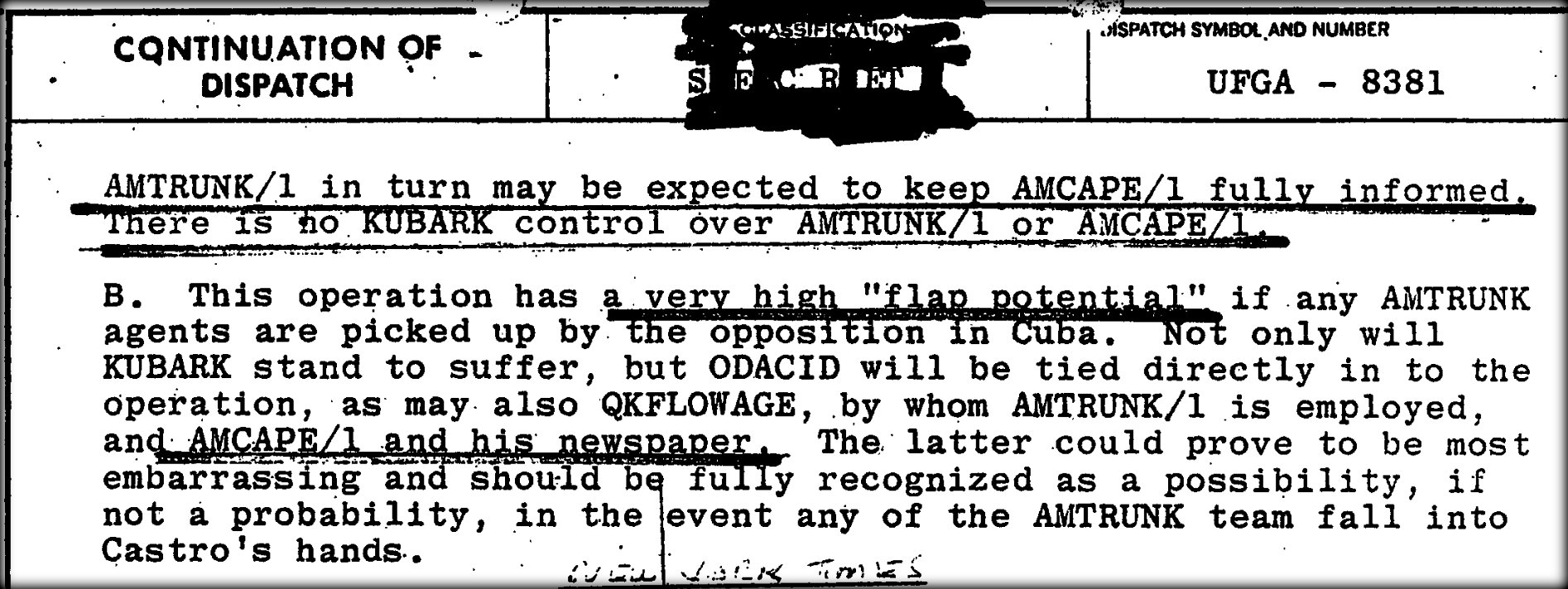
In addition, the Miami station chief warned that Moreno, Volsky, and Szulc—“the AMTRUNKers” as he referred to them—all “admit to being anti-KUBARK” (the Agency’s cryptonym for itself). They were only working with the CIA “because there was no other alternative if they were to accomplish their mission.” In short, from its initiation, AMTRUNK presented multiple security red flags.
At Agency headquarters, officials seemed to concur that “CIA could not at this time be certain that hostile elements were unaware of the plan.” Yet, as a 1977 Agency postmortem on AMTRUNK explained, “for some reason, CIA continued to support the operation.”
Fitzgerald pinned his hopes for the success of AMTRUNK on the top CIA mole inside Castro’s military, Rolando Cubela, aka “AMLASH.” “The keystone of the plan,” notes Brian Latell, the CIA’s former lead analyst on Cuba, “was the use of Cubela to stimulate rebellion in the Cuban military.” In a series of furtive meetings in Brazil and Paris, CIA officers (including Fitzgerald himself) attempted to convince Cubela to organize a military uprising against Castro and/or assassinate him.
On October 4, 1963, a CIA case officer named Nestor Sanchez met with Cubela in Paris. In his report to John McCone, the Director of Central Intelligence, Sanchez relayed that AMLASH was “in a confessional mood” and after getting some things “off his chest a much more relaxed AMLASH departed restating his desire [to] return to PBRUMEN [Cuba] to undertake ‘the big job,’” a possible reference to assassination. Cubela appeared to agree with the AMTRUNK approach; he explained that to get rid of Castro required an operation “organized by as few high-ranking officers as possible.”
In late October, Fitzgerald himself flew to Paris to meet with Cubela, using the alias “James Clark” and posing as a White House official close to Attorney General Robert Kennedy. According to the meeting summary—drafted by Nestor Sanchez who served as the interpreter—Fitzgerald assured AMLASH that the U.S. was “prepared to render all necessary assistance to any anti-communist Cuban group which succeeds in neutralizing the present Cuban leadership” and seizing control of the country. Cubela responded by indicating that mounting a coup would be difficult. There were many military officers that were “convinced that Castro must go,” he claimed. But fear and Castro’s tight control over the government and the country “make it extremely difficult to organize a coup against him.”
Cubela, who may have been acting as a double agent, told his CIA handlers that assassinating Castro was a more promising coup strategy. He asked the CIA to provide him with a sniper rifle; but at a secret meeting in Paris on November 22, 1963—that fateful day that President Kennedy was assassinated in Dallas—Sanchez provided AMLASH with a fake ballpoint pen with a hypodermic needle hidden inside. In the historical folklore of the Agency, the pen remains one of the most infamous of CIA assassination devices.
Throughout the AMTRUNK effort, Agency officials remained concerned about the involvement of “the Amtrunkers”—Szulc, Volsky and Moreno. Moreno participated in the first four infiltrations, but in November 1963, the CIA removed him from AMTRUNK’s most sensitive missions. By the summer of 1964, the CIA officers began to suspect that Volsky might be a communist spy; they also developed such suspicions about Moreno, Szulc, and Cubela. The evidence appeared flimsy but, in CIA evaluations, served to explain AMTRUNK’S repeated failure to foster an anti-Castro coup in Havana.
Over a three-year period, the CIA would plan more than 20 infiltration operations into Cuba as part of Operation AMTRUNK. In the fall of 1964, AMTRUNK agents managed to get some weapons to Cubela and other AMTRUNK assets on the island. However, by February 1965, a CIA officer warned Cubela that some of those agents might be compromised. Indeed, the CIA came to believe that the majority of their AMTRUNK assets on the island were either “controlled or monitored” by the Cuban intelligence service.
In February 1966, Cuban authorities detained Cubela and a co-collaborator, Ramon Tomas Guin Diaz, codenamed AMTRUNK-10. Nevertheless, the Agency continued to pursue Operation AMTRUNK, now renamed STEAMER, for a few more months. The termination of Operation LEONARDO/AMTRUNK/STEAMER finally came on October 30, 1966, when the Agency cancelled the last planned infiltration into Cuba because of “security problems.”
“Like so many other CIA covert Cuba programs of that era, AMTRUNK ended with nothing but another failed regime change effort against Fidel Castro,” according to Arturo Jimenez-Bacardi, who directs the Archive’s CIA history project. But the history of AMTRUNK remains relevant to current CIA efforts to “split the regime,” he concluded. “The fact that Washington is relying on its old playbook, but this time does not even bother to keep a covert operation secret, shows a degree of hubris, recklessness, and a lack of imagination that is likely to only lead to the continued suffering of the Cuban people.”

Document 1
John F. Kennedy Assassination Records Act
In this March 1963 proposal to “split the regime” in Cuba, Desmond Fitzgerald, the head of the CIA’s Special Activities Staff—SAS, a special unit dedicated to overthrowing Castro—recommends a “pincers strategy” of “economic strangulation” coupled with covert operations to identify and recruit dissident members of the military to foment a coup against Fidel Castro. “We will make an intensive effort to identify, seek out and establish lines of communication with disaffected or potentially dissident key personnel in the armed forces,” Fitzgerald advises Director John McCone. “This will permit us to determine whether and under what circumstances they would be prepared to act against Castro.” The proposal is approved and given the cryptonym AMTRUNK.

Document 2
Source John F. Kennedy Assassination Records Act
Operation AMTRUNK was not the CIA’s conception. Instead, the idea of “splitting the regime” by enlisting disgruntled military personnel came from an unlikely source, Tad Szulc, the lead New York Times correspondent on Cuba. In early 1963, Szulc and two collaborators, a USIA official named George Volsky and a Miami-based Cuban exile, Dr. Nestor Moreno, crafted this 6-page “plan of action” to “establish contact with elements within the Government, Rebel Army, and Militia,” and press them “to act now” against Castro. Designated “Operation Leonardo,” the proposal identified more than a dozen potential recruits inside Cuba’s security apparatus. It stated that the plan was “merely a first step towards coordination of anti-Castro elements within the Cuban Government, for producing an internal upheaval.”

Document 3
Source John F. Kennedy Assassination Records Act
This memorandum of conversation records a two-hour meeting between New York Times reporter, Tad Szulc—codenamed AMCAPE-1—and Lt. Col. Albert Davies, a military officer detailed to the CIA’s Cuba task force, to discuss Operation Leonardo. “I advised AMCAPE-1 that I had read the plan and we were interested in fully exploring its possibilities,” Davies reports. After some prodding, Szulc identified USIA official George Volsky as “masterminding the Leonardo Plan” with the help of a Cuban exile Nestor Moreno. Szulc had considered presenting their proposal directly to President Kennedy—identified by his CIA cryptonym GPIDEAL—or Attorney General Robert Kennedy or National Security Advisor McGeorge Bundy. Instead, on February 5, he shared the plan with the special Cuba Coordinating committee in the State Department headed by Robert Hurwitch, who asked that he meet with the CIA the next day. During the conversation with Davies, Szulc calls Volsky and advises him to travel to Washington for a high-level meeting with CIA officials to “further explore the feasibility of their plan.” (That meeting was held in a CIA safe house in Washington D.C. on February 9, 1963.) Davies reports that “AMCAPE-1 is of the firm belief that the concept envisaged by the LEONARDO PLAN is the one sure way of splitting the regime and that the time is NOW.”

Document 4
JFK Assassination Records Act
In this early dispatch, the CIA’s Chief of Station in Miami, Theodore Shackley, minces no words about his concerns regarding AMTRUNK. He recommends that the operation “be terminated at the earliest possible moment” citing “AMTRUNKers” who are uncontrollable and “anti-KUBARK” [CIA], creating clear security issues. “This operation has a very high ‘flap potential,’” Shackley warns. If any member of the AMTRUNK team fell into Castro’s hands, “not only would KUBARK [the CIA] stand to suffer, but ODACID [the State Department] will be tied directly in to the operation, as may also QKFLOWAGE [USIA], by whom AMTRUNK 1 [Volsky] is employed, and AMCAPE-1 [Szulc] and his newspaper [the New York Times]. The latter,” Shackley advised, “could prove to be most embarrassing and should be fully recognized as a possibility, if not a probability….” Since the operation originated from CIA Headquarters, Shackley explains that he will await further guidance while continuing to plan for AMTRUNK’s first two infiltrations. The “operational review” of the dispatch reports on the planning that JMWAVE has completed for these initial operations into Cuba and includes a concise statement of AMTRUNK’s mission: “The project AMTRUNK Mission objective is to overthrow the existing Cuban government by means of a conspiracy among high level military and civilian leaders of the government culminating in a coup d’etat which will oust both Castro and the Communists from power.”

Document 5
Gerald Ford Presidential Library
In response to inquiries from the Senate Select Committee to Study Governmental Activities—the Church Committee—regarding CIA plots to assassinate Fidel Castro, the CIA draws up this four-page historical summary of its ties to Major Rolando Cubela Sacades, codenamed AMLASH. As the highest-ranking Cuban military officer colluding with the CIA, AMLASH was considered key to the success of AMTRUNK. This CIA summary states clearly that “the objective of the AMLASH operation throughout its existence was the formation of a nucleus within Cuba to organize an internal coup to replace the Castro regime.” The report detailed a series of furtive meetings in Brazil and France between Cubela and CIA officials, including the head of the Cuba task force, Desmond Fitzgerald. The Agency authors misleadingly cite Fitzgerald as claiming that he “rebuffed” Cubela’s request for a weapon to assassinate Castro, stating that “the U.S. simply did not do such things.” In fact, the CIA encouraged Cubela to kill Castro to facilitate a coup. On the very day President Kennedy was assassinated in Dallas, a CIA operative met with Cubela in Paris to provide him with a now infamous assassination device created by the agency’s Technical Services Division—a fake BIC ballpoint pen with a hidden hypodermic needle inside to poison the Cuban Comandante.

Document 6
JFK Assassination Records Act
This priority cable from the Paris station to DCI John McCone, summarizes the meeting between Cuban Major Rolando Cubela Sacades (AMLASH), and his CIA handler, Nestor Sanchez. Sanchez reports that Cubela was “much more relaxed” than during their previous meeting in Porto Alegre, Brazil, and was in a “confessional mood.” Cubela explained that over the past year he had felt “highly depressed over belief ODYOKES [U.S. government] did not recognize or appreciate value his position… and what he proposed undertake,” and that the U.S. government was risking his security over minor tasks. Sanchez reaffirmed “our statement of support for him and for a successor regime willing to declare itself anti-Communist.” When Cubela departed the meeting, he reiterated his desire to return to Cuba to undertake “the big job.”

Document 7
John F. Kennedy Assassination Records Act
Reflecting AMLASH’s importance to the success of Operation AMTRUNK, on October 29, 1963, Desmond Fitzgerald—referred to by the codename “Dainold” in this memcon--flew to Paris to personally meet with Major Cubela. He used the alias “James Clark” and posed as a White House official close to Attorney General Robert Kennedy. According to this meeting summary--drafted by Nestor Sanchez who served as the interpreter--Fitzgerald assured AMLASH that the U.S. was “prepared to render all necessary assistance to any anti-communist Cuban group which succeeds in neutralizing the present Cuban leadership” and seizing control of the country. Cubela responded by indicating that mounting a coup would be difficult. There were many military officers that were “convinced that Castro must go,” he claimed. But fear and Castro’s tight control over the government and the country “make it extremely difficult to organize a coup against him.” According to Sanchez’s report, the meeting ended with Cubela inquiring “what technical support we could provide him.”

Document 8
JFK Assassination Records Act
In 1977, during the House Select Committee on Assassinations (HSCA) re-investigation into the assassination of President John F. Kennedy, the CIA established a JFK Task Force to coordinate with the committee. As part of that effort, CIA historians conducted an AMTRUNK file review and created this detailed chronology of the evolution of the operation. The summarized documents, dating from February 1963 to October 1966, record the origins of “Plan Leonardo” as it was presented to the CIA by New York Times correspondent Tad Szulc in early 1963; the CIA designation of the “op” as Operation AMTRUNK; security concerns, and when it was finally terminated as a covert program codenamed STEAMER in late 1966. As early as February 1963, the CIA’s JMWAVE Miami station ran traces of its participants, “some of which looked bad,” according to their assessment. Indeed, from its inception AMTRUMK was plagued by “red flags” and security concerns. One chron entry dated in September 1965 advised that no less than ten AMTRUNK assets the CIA had recruited should be considered “controlled” or “monitored” by Cuba’s intelligence service, the DSE. Yet because AMTRUNK “was presented to CIA through level requiring thorough consideration” the program moved forward. In April of 1964, Langley headquarters sent a secret cable to key stations stating that “the CIA was making intensive effort to seek out disaffected key personnel in Cuban Armed Forces, with aim of uniting and turning non-Communist elements against Castro regime.”

Document 9
John F. Kennedy Assassination Records Act
The CIA’s JFK Task Force drafted two AMTRUNK postmortems to address HSCA inquiries. This first report begins defensively, pointing the finger of responsibility at the Kennedy White House: “Review of this file leaves no doubt that CIA was being pressured by Higher Authority, as far back as early 1962, or earlier, to come up with an operational plan for actions against Cuba with the eventual aim of overthrowing the Castro regime.” The report conducts an overview of some of the Cuban officials the CIA attempted to recruit; it assesses whether they might have been “run back against us.” Major Rolando Cubela, aka AMLASH, receives special attention as a potential double agent. “CUBELA reportedly had all the tools necessary to carry out an assassination of CASTRO, and probably some opportunities, had he really wanted to do so,” the report suggests. “Perhaps he was sent by the GOC [Government of Cuba] to confirm whether the U.S.G./CIA would support executive action.”

Document 10
John F. Kennedy Assassination Records Act
In an effort to explain the failure of AMTRUNK, this second CIA postmortem asserts that “It is possible that the AMTRUNK Operation might have been a political action operation run against the U.S.G./CIA.” The report seeks to address why so many military officers the CIA attempted to recruit in Cuba had been identified and detained by the Cuban G-2, the counter intelligence division of Cuba’s intelligence agency, the DSE. “All of the principals of the AMTRUNK network active during 1963 and 1964 had been rolled up,” along with six other “former AMTRUNK internal assets” in 1965 and 1966, according to the study. The Cubans “might have succeeded in obtaining CIA financial and material support for an operation which was controlled by the planners,” the report postulated. “They succeeded, it seems, in identifying, neutralizing, and exposing on-island anti-Castro forces, and tying up CIA time, money, and manpower for an operation of their own creation.” The CIA postmortem cast suspicion on Rolando Cubela, as well as “the principal initiators, Tad SZULC, Jorge VOLSKY and MORENO.” Those AMTRUNK operatives, according to the report, “made it known that they were anti-U.S.G. and anti-CIA and accepted assistance only to accomplish their own purposes. They were not under CIA control.”