On Eve of Raul Castro Indictment, Archive Posts Declassified FAA Documents
on Events Leading to Shootdown of Cuban Exile Planes
FAA Emails Foresaw “Worst Case Scenario”
“One of these days the Cubans will shoot down one of these planes”
On Eve of Raul Castro Indictment, Archive Posts Declassified FAA Documents
on Events Leading to Shootdown of Cuban Exile Planes
FAA Emails Foresaw “Worst Case Scenario”
“One of these days the Cubans will shoot down one of these planes”
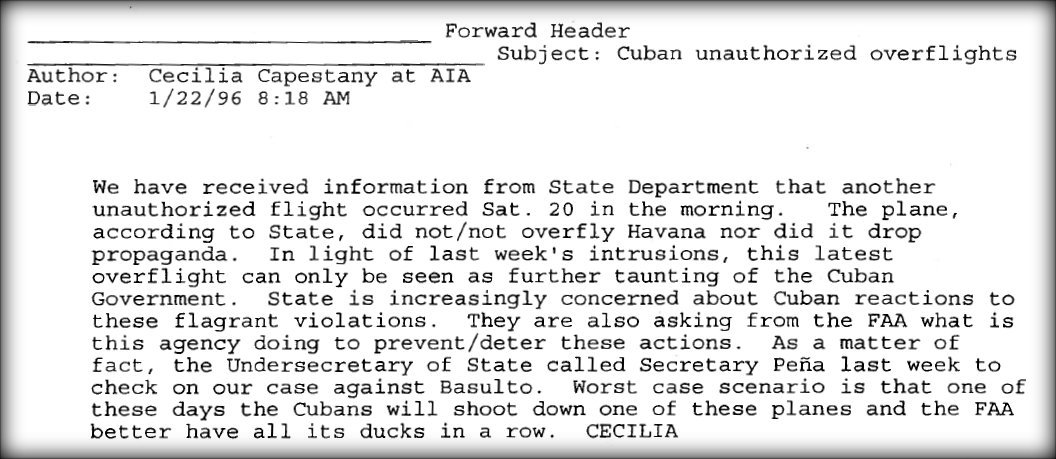
Washington, D.C., May 19, 2026 - One month before Cuban MiG aircraft shot down two unarmed Cessna planes off the island coast, a Federal Aviation Administration (FAA) official cited “further taunting of the Cuban Government” by the Brothers to the Rescue (BTTR) overflights and State Department concern about a “worst case scenario” in which “one of these days the Cubans will shoot down one of these planes and the FAA better have all its ducks in a row.” The declassified FAA email is one of several records on the shootdown published today by the National Security Archive.
FAA emails, memos, and communications recorded concerns among high-level Clinton administration officials that repeated penetrations of Cuban airspace would eventually lead to a crisis if Cuba acted to protect its territorial integrity from provocative BTTR incursions. “A major fear is the possible downing of a BTTR aircraft by land-based gunfire,” a summary of an August 1995 meeting with White House officials stated.
The posting comes as the U.S. Department of Justice prepares to indict Cuban leader Raul Castro for his role in the downing of the BTTR planes. At the time, General Castro served as minister of defense and was the highest officer in the military chain of command in Fidel Castro’s government. The documents offer a detailed historical context in which the aerial violence against the civilian aircraft occurred.
The FAA records also provide significant details on events leading up to the February 24, 1996, downing of the planes, which cost the lives of four Cuban American members of BTTR. Among those details:
The FAA documents were obtained through the Freedom of Information Act (FOIA) for the 2014 book, Back Channel to Cuba: The Hidden History of Negotiations Between Washington and Havana, by American University Cuba specialist William LeoGrande and Archive senior analyst Peter Kornbluh. The book detailed multiple backchannel attempts by Cuban leaders, including Fidel Castro, to press the Clinton Administration to halt the provocative BTTR flights. In January 1996, Castro personally struck a secret deal with then Congressman Bill Richardson to release several political prisoners in return for an ironclad promise from President Clinton to ground Basulto’s planes. Although Richardson told Castro he had obtained that commitment from the President, in reality he had talked to other White House aides who had then appealed to Secretary Peña to intercede with the FAA.
On the night of February 23, according to Back Channel to Cuba, the White House official in charge of Cuba, Richard Nuccio, sent an email to National Security Advisor Sandy Berger alerting him that Basulto intended to fly the next day. “Previous overflights by Jose Basulto of the Brothers have been met with restraint by Cuban authorities,” he reported. “Tensions are sufficiently high within Cuba, however, that we fear this may finally tip the Cubans toward an attempt to shoot down or force down the plane,” he warned.
Nuccio called FAA officials in Miami and instructed them to block the flights. To his surprise, they refused. The FAA agreed only to warn Basulto, again, against violating Cuban airspace. In their book, the authors described the shootdown as “a Greek tragedy that played out in the skies over Cuba.”

Document 1
National Security Archive FOIA Request
One month before the shootdown of two BTTR planes, FAA official Cecilia Capestany informs her superiors that the State Department has called to press the agency to ground further flights by Jose Basulto, the leader of BTTR. She also cites a call from Undersecretary of State Peter Tarnoff to Transportation Secretary Federico Peña “to check on our case against Basulto.” Her email identifies the “worst case scenario that one of these days the Cubans will shoot down one of these planes and the FAA better have all its ducks in a row.”

Document 2
National Security Archive FOIA Request
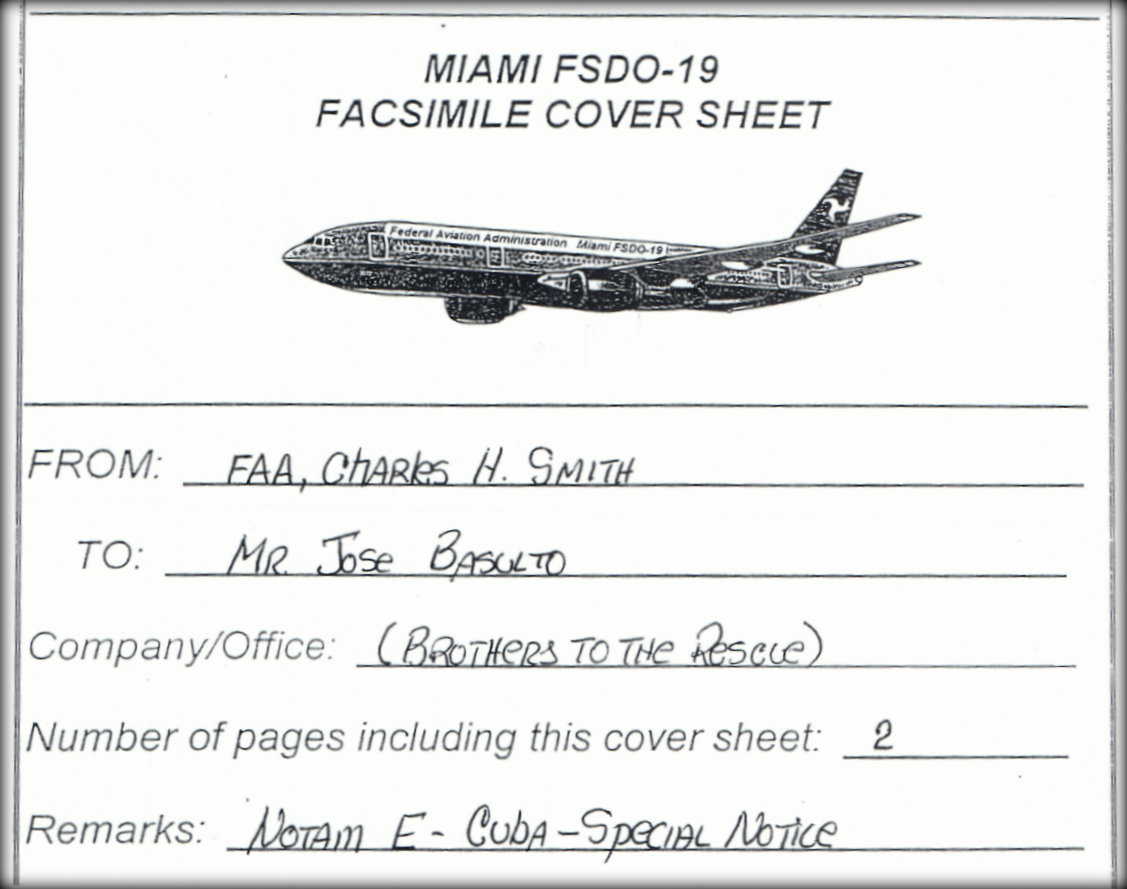
This comprehensive overview of FAA meetings and communications leading up to the shootdown was drafted by the agency’s Miami Flight Standards District Office manager, Michael Thomas. It describes multiple warnings sent to Basulto by FAA officials, as well as a meeting with “White House point man on Cuba” Richard Nuccio in August 1995 after a provocative BTTR overflight of Havana during which thousands of leaflets and medallions were dropped from the skies on the city streets. “A major fear is the possible downing of a BTTR aircraft by land-based gunfire,” the description of the meeting concluded. A subsequent State Department announcement cited the “FIRM DETERMINATION” of the Cuban government to defend its territorial integrity and airspace from unauthorized incursions.

Document 3
National Security Archive FOIA Request
This FAA chronology covers interactions and communications between FAA officials and Jose Basulto between early 1995 and January 1996. While it records repeated notices and warnings to BTTR to halt its violations of Cuban airspace, it also reflects a bureaucratic inability to ground, once and for all, Basulto’s ongoing provocations and address Cuban government protests that violations of its airspace continued.

Document 4
National Security Archive FOIA Request
This FAA chronology specifically charts—hour-by-hour, minute-by-minute—the fateful events of February 24, 1996, when the two BTTR planes were shot down by Cuban MiGs off the coast of the island. The record includes transcripts of the communications between the Cuban government flight controllers and Basulto and the other BTTR pilots. When Basulto issued “a cordial greeting from Brothers to the Rescue and its President Jose Basulto” and announced that the planes would be flying over northern Havana, the Cuban air traffic controller warned him “that the zone north of Havana is active. You run danger by penetrating that side of North 24.” According to the transcript Basulto responded: “We are aware that we are in danger each time we cross the area to the south of the 24th. But we are willing to do it as free Cubans.” “Copy that information,” the Havana air controller replied.

Document 5
National Security Archive FOIA Request
Only after the shootdown and death of the four BTTR pilots did the FAA issue a “cease and desist” order against Basulto. The order accused him of operations that were “careless or reckless so as to endanger the lives or property of others.” The FAA directive stated that Basulto and BTTR are “now and in the future ordered to cease and desist from the operation of any civil aircraft within the territorial airspace of the Republic of Cuba.”