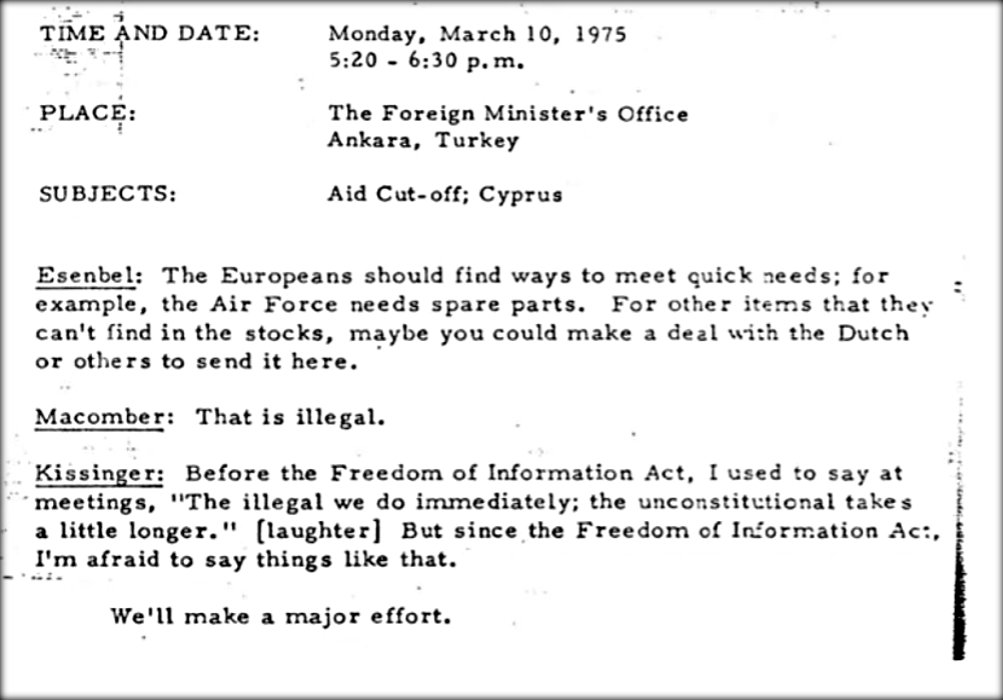
Telcon of meeting between Henry Kissinger and Turkish Minister of Foreign Affairs Melih Esenbel
Like King George III, Trump Claims Ownership of Public Records
Telcon of meeting between Henry Kissinger and Turkish Minister of Foreign Affairs Melih Esenbel
Like King George III, Trump Claims Ownership of Public Records
Washington, D.C., July 9, 2026 - Sixty years after President Lyndon B. Johnson reluctantly signed the Freedom of Information Act (FOIA) into law, Americans enjoy a national transparency treasure in their ability to request, obtain, and analyze the records of their own government. Yet obtaining those records has rarely been slower, more difficult, or more uncertain than it is today.
In the last ten years, massive agency backlogs, the dismantling of FOIA offices, and, more recently, disappearing public datasets and renewed assertions of executive control over government records have prompted a difficult question: Can the legal right to know survive while the practical ability to exercise that right steadily erodes, and when the President claims White House records are his personal property?
The irony is striking as the United States celebrates its 250th anniversary. The American Revolution was a rejection of arbitrary executive authority exercised by a distant monarch. Two centuries later, Congress passed FOIA to reaffirm another revolutionary principle: that government information belongs not to the executive branch, but to the public.
From the Declaration of Independence to the passage of FOIA in 1966, through the Watergate reforms that transformed the law into one of the world’s strongest transparency statutes, and finally to today’s new challenges, public ownership of government records has been a fundamental feature of democratic government.
Among the primary grievances listed against King George III in the Declaration of Independence was that the King’s government was not subject to meaningful accountability.
“[The King of Great Britain] has called together legislative bodies at places unusual, uncomfortable, and distant from the depository of their public Records, for the sole purpose of fatiguing them into compliance with his measures.” – The Declaration of Independence, July 4, 1776.
By extension, the founders of the United States rejected the tradition that official information belonged to the Crown. Britain’s doctrine of Crown Copyright reflected this philosophy: the sovereign exercised legal control over official government publications and records. But the framers set the United States on a different course in adopting the Constitution’s Copyright Clause:
“Congress shall have Power…To promote the Progress of Science and useful Arts, by securing for limited Times to Authors and Inventors the exclusive Right to their respective Writings and Discoveries” – United States Constitution, Article I, Section VIII, Clause VIII.
The Copyright Clause laid the foundation for the 1895 Printing Law, which said that “Government Publications” could not be copyrighted, and later the 1976 Copyright Act which ensured that “copyright protection under this title is not available for any work of the United States Government.” Government existed as an instrument of the people, and over time, public records increasingly came to be understood as belonging to the public rather than the executive.
That principle, however, remained largely aspirational throughout much of American history. Federal agencies routinely treated their records as internal property, disclosing information only when politically convenient. During the Cold War, secrecy expanded dramatically across the executive branch. By the 1950s, journalists, historians, and members of Congress complained that the federal bureaucracy had developed a culture of reflexive secrecy.
No individual challenged that culture more persistently than Representative John Moss of California. Following numerous reports that federal agencies were refusing even routine requests for information, Moss began what became an eight-year legislative campaign to establish a statutory right of public access.
A Democratic congressman from Sacramento, California, Moss is the real hero of the freedom of information story. Supported by extensive press coverage and the active lobbying by newspaper editors, Moss led hearings beginning in 1955 that documented and denounced excessive government secrecy. His investigations revealed a bureaucracy that routinely denied records without legal justification, citing vague notions of administrative discretion or national security. Agencies often treated public information as a privilege to be granted rather than a right guaranteed by law.
Nearly every major executive agency opposed Moss’s legislation. An August 1965 Bureau of the Budget analysis noted that the Justice Department considered the bill unconstitutional, and remarked, “The requirement that information be made available to all and sundry, including the idly curious, could create serious practical problems for the agencies.” The executive branch warned that mandatory disclosure would cripple government operations and threaten national security.
Moss persisted, famously describing FOIA as the product of a sustained legislative effort against entrenched bureaucratic opposition. His campaign fundamentally altered the relationship between citizens and their government. Instead of requiring Americans to prove why they deserved access, FOIA required the government to justify secrecy.
President Lyndon B. Johnson never embraced the legislation and worried that expanded public access would interfere with executive decision-making and inhibit candid international discussions. Although he ultimately signed the FOIA in 1966, he did so reluctantly and with minimal publicity. He personally handwrote “No ceremony” across the bottom of a June 24 memo about the possibility of a signing event with leading editors and legislators.
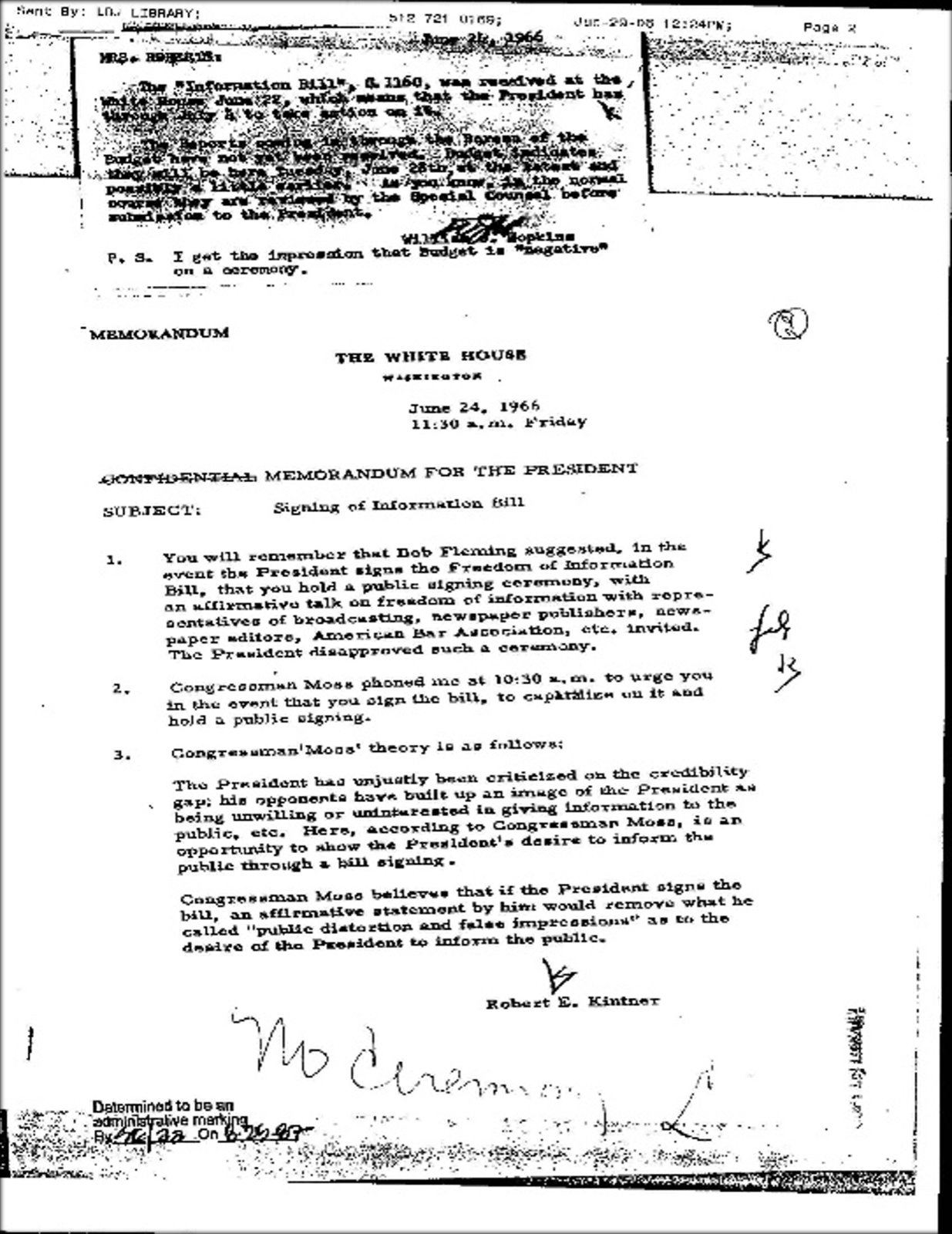
Memorandum for President Lyndon B. Johnson about the signing of the Freedom of Information Bill. At the bottom of the page is Johnson's handwriting: "No ceremony"
Like Johnson, subsequent presidents frequently endorsed transparency in principle, while, behind closed doors, they resisted statutory limits on executive control over information.
Less than a decade after Johnson signed FOIA into law, President Gerald Ford in 1974 was set to sign legislation that would strengthen the Freedom of Information Act, but concerns about leaks (shared by his chief of staff Donald Rumsfeld and deputy chief of staff Richard Cheney) and legal arguments that the bill was unconstitutional (marshaled by government lawyer Antonin Scalia, among others) persuaded Ford to veto the bill.
As negotiations between the administration and congressional offices stalled, Thomas Susman, a key member of the congressional staff working on the 1974 amendments as counsel to Senator Edward Kennedy (D–Mass.), learned that the FBI had ceased its negotiations with Congress because it wanted the proposed legislation to be “as bad as possible” to make the case stronger for a presidential veto. Congress overrode the veto by overwhelming bipartisan margins.
The year after FOIA was amended and substantially reinforced, Secretary of State Henry Kissinger nodded to the (potential) power of FOIA in his conversation with Turkish Foreign Minister Melih Ensenbel:
“Before the Freedom of Information Act, I used to say at meetings, ‘The illegal we do immediately; the unconstitutional takes a little longer.’ [laughter] But since the Freedom of Information Act, I’m afraid to say things like that.” -Henry Kissinger, March 10, 1975
Kissinger nevertheless went on to explain how he would facilitate the illegal circumvention of a congressional arms embargo.
During the following decades, Congress repeatedly modernized FOIA. But alongside late-20th and early-21st century advancements to FOIA, one of the greatest transparency ironies emerged: government has simultaneously become more visible and less accessible. On the one hand, electronic records, online reading rooms, and searchable government databases promised to transform government transparency. On the other hand:
Sixty years after the Freedom of Information Act was signed into law, the statute remains one of the most consequential democratic reforms ever enacted by Congress. Its central premise—that government records belong to the public unless secrecy can be justified—fundamentally transformed the relationship between the public and the federal government.
But FOIA has never been self-executing. The struggle did not end with President Johnson’s reluctant signature in 1966, nor with Congress’s override of President Ford’s veto eight years later. It continues today in debates over agency resources, preservation of digital records, executive control over information, and the public’s ability to obtain government documents within a meaningful timeframe. As the United States commemorates both the 60th anniversary of FOIA and the nation’s 250th birthday, it’s important to remember that transparency is not a permanent achievement but an ongoing democratic obligation.