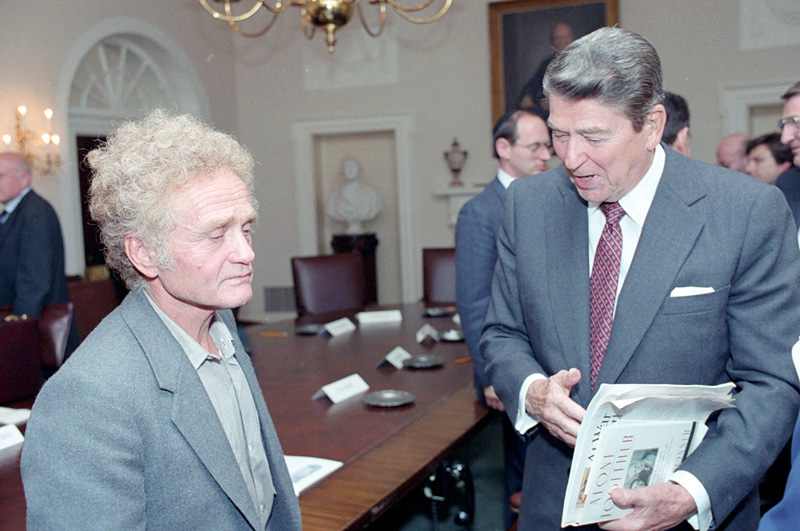
Soviet dissident physicist Yuri Orlov meets President Reagan just before Reykjavik, October 7, 1986.

Soviet dissident physicist Yuri Orlov meets President Reagan just before Reykjavik, October 7, 1986.
Reagan believed that there could be no arms control without progress on human rights and in private meetings put pressure on the Soviets to make reforms. Gorbachev believed in opening his society and reforming the country. Human rights issues became a major subject in negotiations and at every summit and ministerial meeting. Soviet internal documents show that American quiet pressure was effective. As a result, by the late 1988, Soviet political prisoners were released, the practice of psychiatric confinement for dissidents was ended, and hundreds of Jewish refuseniks received exist visas and emigrated from the USSR. This progress allowed the Soviet Union to hold a CSCE humanitarian conference in Moscow in 1991.

Document 1
Ronald Reagan Presidential Library
Just before Ronald Reagan’s first summit with the Soviet leader at Geneva in November 1985, the American president dictated his thoughts about the summit process and dealing with the Soviets in this previously classified memo. In a secret internal memo to his successor as the National Security Council, Russia hand Fritz Ermarth, Jack Matlock described it this way: “This is a revealing, but highly sensitive paper. It was dictated by the President last year a few weeks before the Geneva (the corrections are also his). It provides excellent insight into his thinking re summitry and dealing with the Soviets.”
Among many remarkable lines, Reagan reminded himself, “let there be no talk of winners and losers. Even if we think we won, to say so would set us back in view of their inherent inferiority complex.” Perhaps most striking is Reagan’s language about keeping quiet on human rights: “I’m sorry we are somewhat publicly on record about human rights. Front page stories that we are banging away at them on their human rights abuses will get us some cheers from the bleachers, but it won't help those who are being abused.” This thinking became the basis for a quiet diplomatic ritual at every summit where Reagan would hand Gorbachev a list of individual cases of dissidents and refuseniks, and Gorbachev would actually take action on them, albeit slowly, so as not to seem under pressure.

Document 2
Ronald Reagan Presidential Library
As Reagan was preparing for the Geneva summit, he put a lot of thought into how to approach the Soviets on the issue of human rights. This meeting was scheduled to last only a quarter of an hour, but it runs for 70 minutes. Reagan chooses this private meeting, after a lavish dinner the night before, to give Gorbachev a lecture about human rights and their importance in the U.S. political system. However, the way he speaks to his Soviet counterpart is very different from his public speeches on the subject. Here, he promises never to take credit for any Soviet responsiveness on individual cases, signals his understanding that quiet diplomacy is more effective, cites the release of the Pentecostals who had been isolated in the U.S. Embassy in Moscow, and generally bends over to tell Gorbachev: this is really important to me, and to the American people and the Congress; progress here will really help. Reagan cites individual cases and tells human stories, but Gorbachev still sees propaganda in every mention of human rights, no matter how quiet and private. He responds with typical Soviet lines about human rights violations in the United States and other Western countries. In his view, pressure from Congress or interest groups is just a pretext for interfering in Soviet internal affairs. Gorbachev sounds like he is uncomfortable with the subject and eager to get to the plenary meeting.

Document 3
Russian State Archive of Contemporary History (RGANI), Fond 89, opis 18, delo 102 (on file at the National Security Archive)
Reagan’s deep commitment to human rights in the Soviet Union was certainly noticed by the Soviet KGB. Chairman Viktor Chebrikov, working at cross purposes with his country’s leader, Gorbachev, decided in late July that it was time to push back on the U.S. “anti-Soviet” human rights campaign. Chebrikov’s memo talks about the need to take “special measures” to prevent U.S. Embassy officials and journalists from talking about human rights violations in the Soviet Union. He is especially adamant about the “renegades” (great Russian word отщепенцы ) “whose names are actively used by the Western mass media in their anti-Soviet campaign.” He has in mind exactly the people who would be on Reagan’s lists of dissidents that would be given to Shevardnadze and Gorbachev in preparation for Reykjavik. Chebrikov’s suggestions to push back on the work of Western journalists most likely contributed to the framing of Nicholas Daniloff in August, which almost ruined the possibility of a summit with Reagan, the top priority for Gorbachev at the time.

Document 4
Ronald Reagan Presidential Library
After American journalist Nicholas Daniloff, Moscow bureau chief of U.S. News and World Report, is arrested in Moscow on fake espionage charges, Reagan fires off a quick but decisive letter to Gorbachev demanding Daniloff’s release. He gives Gorbachev personal assurances that Daniloff is not involved in espionage and warns that “if he is not freed promptly, it can only have most serious and far-reaching consequences for the relationship between our two countries.” The Soviets grabbed Daniloff to exchange him for Gennady Zakharov who was detained two weeks earlier on espionage charges in New York. Reagan refused any linkage between the cases of an innocent journalist and a spy.

Document 5
Ronald Reagan Presidential Library, published in FRUS
This document includes notes from three meetings on September 19: between Shultz and Shevardnadze, President Reagan and Shevardnadze, and another one between Shultz and Shevardnadze. Shultz and Shevardnadze discuss the “humanitarian cases,” including the cases of Nicholas Daniloff and Gennadi Zakharov, the action of expelling 25 U.S. diplomats, and the release of political prisoners from the Soviet Union.
Shevardnadze begins the meeting by stating that he desires to meet with President Reagan to transmit a letter from Gorbachev. In the letter, Gorbachev writes that a meeting between the President and the General Secretary is “necessary to make progress in Soviet-American relations” and proposes a quick meeting in Reykjavik or London.
On the topic of Daniloff and Zakharov, Secretary Shultz stresses that Daniloff was not working for the U.S. government and was not guilty of the charges brought against him. He emphasizes that this case decreased the trust between the U.S. and the USSR. In response, Shevardnadze states that he believes that a “great propaganda machine” had been set in motion, and that even if the incident with Daniloff and Zakharov had not happened, he was “sure that other pretexts could be found to poison the atmosphere” of U.S.-Soviet relations and undermine the possibility of a summit, something that Shevardnadze became even more sure of after the expulsion of the Soviet UN employees that was announced on September 17.
Shevardnadze and Shultz disagree over whether it is possible to prove that their respective detained citizens had been acting on the instructions of the other government. But they do agree that Daniloff’s case is very different from Zakharov’s.
Shevardnadze and Shultz then discuss the expulsion of the 25 Soviet diplomats, with Shevardnadze describing it as a “new stage of Soviet-US confrontation,” noting that the USSR would “have to reply in kind,” and proposing that both Daniloff and Zakharov be tried quickly, be freed into the custody of the ambassadors, and that both countries should take further actions “without dramatization.” Shevardnadze stresses the “very detrimental effect” of the expulsion of the diplomats.
Shultz talks forcefully about human rights, saying that “[e]verything centered on the US perception of the way various individuals, human beings, are being treated. He links progress on human rights directly to the situation in U.S.-Soviet relations and names specific individuals that had to be allowed to leave the USSR, starting with Andrey Sakharov, Elena Bonner, Ida Nudel, Yuri Orlov, Anatoly Koryagin, Anatoly Marchenko, and Irina Ratushinskaya. Shevardnadze agrees that some of these people could be freed if the decision to hold a summit is made in principle. He acknowledges that the U.S. had a “certain practice in this area,” mentioning the lists of names that were presented before by the Secretary, Ambassador Hartman and the President. He promises that the “lists will be carefully examined” and that decisions will be made in each case, but that Sakharov could not be allowed to emigrate. Shultz interjects that “Sakharov could be allowed to live in Moscow.” They agree that the practice of presenting the lists would continue and “these issues needed to be resolved confidentially.”
The two spend some time clarifying where each country stands on the issue of certain individuals being allowed to leave the Soviet Union. Shevardnadze and Shultz discuss the grouping of the three issues (Zakharov, Daniloff, and the release of other groups of people), with Shultz describing the events as unrelated but taking place at the same time and Shevardnadze stating that the first two issues and the issue of emigration are not connected. Shevardnadze proposes two paths forward: either freeing both Zakharov and Daniloff immediately or having a trial and an exchange quickly. Regarding emigration, Shevardnadze proposes that the U.S. give the USSR a list of people, and that the Soviet side would review it and make determinations on a name-by-name basis.
In Shevardnadze’s brief meeting with President Reagan in the Oval Office, the Soviet Foreign Minister discusses the contents of the letter that Gorbachev wrote to the President, highlighting Gorbachev’s desire for a meeting with the President that Gorbachev views as “necessary in the current crisis situation” between the U.S. and the USSR. Reagan welcomes the message but then speaks “at length and very emotionally about the Daniloff case,” making it clear that no further progress would be made on the summit unless this case is resolved. In his diary, Reagan describes the meeting with Shevardnadze and how he gave Shevardnadze a lecture on the differences between the two political systems in how they treat individuals. Reagan was angry and enjoyed showing it to Shevardnadze.[1]
In their final private meeting this day, Shevardnadze and Shultz discuss the expulsion of Soviet UN diplomats in more detail. Shevardnadze repeats the significance of the expulsion of the diplomats and states that “actions might be taken whose consequences might be difficult to predict.” Shultz gives the promised two lists of names of dissidents and Jewish refuseniks to the Soviet Foreign Minister to consider before the proposed summit.

Document 6
Ronald Reagan Presidential Library, published in FRUS
In a follow-up to the conversations held the day before, Shultz continues his unrelenting pressure on Shevardnadze on human rights, knowing that the Soviets will have to make serious concessions if they want the meeting in Reykjavik. After a discussion of the Soviet UN diplomats’ expulsion and an effort to explain to Shevardnadze the rationale behind it, the Secretary of State moves to the lists that he gave the Foreign Minister the day before. He gives Shevardnadze President Reagan’s positive response to the idea of meeting in Reykjavik but makes it very clear several times during the conversation that it could only happen if there is a Soviet response to the cases on the list. Shultz suggests that the Soviets release some of the people on the list on their own initiative, as a “humanitarian gesture,” without linkage to any other issues. Exasperated, Shevardnadze jokes that “the USSR had given the US Shcharansky, and what had it gotten in return?” Shultz jokingly replies that that “what it had gotten was that the US was no longer screaming about Shcharansky.”

Document 7
Archive of the Gorbachev Foundation, Moscow
Foreign Minister Eduard Shevardnadze reports to the Politburo on his talks in Washington and informs the Soviet leadership about Reagan’s decision to accept Mikhail Gorbachev’s invitation to meet in Reykjavik on the condition that American journalist Nicholas Daniloff, accused of spying against Moscow, is released and that some “positive action” is taken on the U.S. list of leading Soviet dissidents, including Yuri Orlov. Gorbachev accepts the conditions and sets forth his main ideas for the summit. It is decided that Orlov will be released within a month to make the Reykjavik summit possible and that other dissidents will be released later. Daniloff will be exchanged for Soviet spy Gennadi Zakharov. This shows that Orlov was released in direct connection with the Reykjavik summit as a result of Reagan’s pressure but not as part of the exchange for Daniloff, as reported at the time.

Document 8
Ronald Reagan Presidential Library, published in FRUS
In the President’s office at the United Nations, Shultz and Shevardnadze discuss the Zakharov and Daniloff cases, Soviet consideration of the lists of dissidents Shultz handed to the Soviet foreign minister on September 20, and the expulsion of Soviet UN personnel.
When discussing the Zakahrov and Daniloff cases, Shultz outlines the proposed plan for releasing the detainees: Daniloff would be released without trial, then, 24 hours later, Zakharov would be released, and with his release several other people would be released as well, including Yuri Orlov. Shultz also noted that the U.S. would still like the USSR to remove its intelligence personnel from the UN mission. Both sides agree on how they will respectively release information about the releases.
Shevardnadze confirms that Yuri Orlov will be released and emphasizes that “the decision on Orlov would not have been possible without the direct intervention of Gorbachev.” When discussing Shultz’s proposed plan, Shevardnadze expresses two differences: the amount of time between the releases of Zakharov and Orlov (the USSR wanted to release Orlov ten days after Zakharov and to gradually consider the cases of other people that the U.S. wished to have released). Shultz says that he would let the President know that “Gorbachev personally was responsible for the decision to release Orlov” but pushes for more people from the list.
Shevardnadze talks about the 25 people on the UN personnel list, bringing up the point that he knew three of them personally and noting the impact that being expelled would have on their reputation—for example the impact it would have on their families. No amount of pleading from the Soviet foreign minister changes the U.S. position; Shultz confirms that the UN spies will be expelled.
Towards the end of the conversation, Shevardnadze and Shultz agree on how they will relay information back to Reagan and Gorbachev. Schultz mentions two more things not related to the case at hand: Schultz compliments the “forcefulness” of the Foreign Minister’s UN speech and the Foreign Minister’s desire to eliminate nuclear weapons. The Secretary adds that he met with the Chinese Foreign Minister, who asserted that if the U.S. and Soviet Union both took steps to “drastically” reduce their nuclear arms, China would consider participating in the process of eliminating nuclear weapons as well. Finally, Shultz mentions that he believes that there are prospects for good U.S.-USSR relations, that progress is possible, and that “the two sides should not be burdened by the current difficulties.”

Document 9
Ronald Reagan Presidential Library
This pair of documents—the talking points for Reagan and his actual statements—attest to the attention Reagan paid to the issue of human rights in the USSR in the lead-up to the Reykjavik summit. The assessment of the U.S. officials in preparing this background is that the Soviets “wish to turn these meetings exclusively into arms control forums.”
Recently released Soviet dissident physicist Yuri Orlov and journalist Nicholas Daniloff were present during Reagan’s remarks in the Cabinet Room of the White House. Reagan stated that he would “make it amply clear to Mr. Gorbachev that unless there is real Soviet movement on human rights, we will not have the kind of political atmosphere necessary to make lasting progress on other issues.” Intimately and clearly connecting human rights with arms control in this fashion was core to the U.S. goal of forcing the Soviets to the table on human rights and promoting their four-part agenda: arms control, regional conflicts, bilateral issues, and human rights.

Document 10
Margaret Thatcher Foundation
On October 9, Assistant Secretary of State Rozanne Ridgeway and Ambassador Paul Nitze briefed the allies on U.S. positions and preparations for the Reykjavik summit. While Nitze talked about nuclear arms control and space issues, Ridgeway focused on human rights and East-West issues. UK Ambassador Alexander summarizes her presentation stating that “Human rights will head US agenda.” Ridgeway says that the Reagan administration “had concentrated on quiet diplomacy and the Russians had appeared willing to meet US concerns.” Calling the current situation with human rights and Jewish emigration in the Soviet Union “dismal,” she emphasizes “the president’s determination to highlight human rights,” and especially divided family cases. Generally, both Ridgeway and Nitze, according to Alexander, were “to dampen expectations over Reykjavik. No breakthroughs expected.”

Document 11
Ronald Reagan Presidential Library, Matlock Files, Box 18
This paper was prepared by the State Department. It includes a general review of recent progress on human rights achieved since the last summit in Geneva, U.S. current concerns about the Soviet practices, and specific suggestions for the Soviets to improve their record and thus contribute to the improvement of U.S.-Soviet relations. Noting that the Daniloff case “seriously damaged our relations,” the paper emphasizes “the importance we attach to individual rights and the lengths we are prepared to go when individual rights are violated.” Important parts of the U.S. human rights agenda are Jewish emigration and divided families. The paper ties these issues directly to progress in other spheres in the relationship, including “progress in overcoming Jackson-Vanik amendment trade/credit limitations.” The U.S. position notes specifically the cases of “prominent human rights activists such as Sakharov.” The paper welcomes “new willingness on the part of the Soviet Union to consider human rights legitimate topic of discussion.” A separate paper on the situation with Jewish emigration was also given to the Soviets as part of human rights presentation.

Document 12
Ronald Reagan Presidential Library, Matlock Files, Box 18
This memo registers the discontent of the National Security Council with the paper on human rights presented to Gorbachev in Reykjavik on October 11 (see Document 11 above) calling the paper “seriously flawed.” The State paper was not coordinated with the NSC staff and was presented to them only after the paper had been presented to the Soviets. Matlock criticizes the State paper for not being fully accurate and points out inaccuracies and mistakes on individual cases and suggests specific recommendations. He emphasizes that the NSC staff “attempted repeatedly to obtain these materials from State and to participate in developing them, but met a stonewall” and requests that, in the future, they have access to review materials presented to the president. This small turf battle is one more piece of evidence indicating that human rights was an important issue for Reagan and that the NSC staff did not like being excluded from this discussion.

Document 13
Russian State Archive of Contemporary History (RGANI), Fond 89, opis 18 (on file at the National Security Archive)
In a gesture of glasnost and on the eve of the Moscow International Forum “For a Nuclear-Free World, for the Survival of Mankind,” Gorbachev allowed two leading American scientists, Stone and von Hippel, to visit Andrey Sakharov, father of the Soviet thermonuclear bomb and the most famous Soviet human rights activist, who just recently returned to Moscow from his exile. Sakharov’s was one of the names on the list given to the Soviets before Reykjavik, and Shultz asked for his release repeatedly. This amazing conversation took place in Sakharov’s apartment, which was bugged by the KGB. Ironically, we owe our ability to read this transcript to KGB Chairman Chebrikov, who sent it to Gorbachev.
The conversation centered on arms control and the common position critical of Reagan’s SDI that the scientists shared. Sakharov was going to speak at the Forum in three days and was planning to call for delinking strategic defenses from the rest of arms control and, in so doing, untie the Soviet arms control package. All three of the physicists at the kitchen table agreed on this. Sakharov reflects on the Soviet position in Reykjavik, saying he is “far from certain that Gorbachev has a full mandate to implement the proposals he made at Reykjavik. Perhaps this goes further than what he can realistically obtain from the General Staff.” His American interlocutors think Gorbachev was in control of his positions and that the Soviet experts “were making very many concessions.”
In the end of the conversation, Stone gives Sakharov a letter from Senator Edward Kennedy inviting him to visit the United States. Sakharov says he cannot travel outside USSR because the state says he had access to secret information. In Sakharov’s view, the state must change its position, but he would not initiate the request himself.

Document 14
Ronald Reagan Presidential Library, Fritz Ermarth Files
This short paper was prepared for Reagan by the NSC staff on the eve of the Washington Summit to use in his conversation with Gorbachev. It would be accompanied by a short list of still unresolved humanitarian cases. While noting progress on human rights, the talking points say that “the results have fallen far short of our expectations.” This time Reagan would go beyond the lists and urge Gorbachev to increase religious freedom, end psychiatric abuse, and give human rights gains some degree of permanence by reforming Soviet laws and practices.” The paper notes that there was practically no progress in the last two months. However, as the NSC officials were preparing the paper, the Soviets were preparing a pleasant pre-summit surprise for Reagan—hundreds of political prisoners and refuseniks were either pardoned or given exit visas.

Document 15
State Department declassification, National Security Archive FOIA request
Following Reagan’s personal request, the last full summit, his state visit to Moscow, was full of activities engaging with Russian people. The U.S. president wanted to meet with religious believers and with dissidents. He was invited to visit the Danilov Monastery in Moscow and meet with monks, gave a speech at Moscow State University, and met with a large group of dissidents and refuseniks. This cable, written by U.S. ambassador Jack Matlock, describes a highlight of Reagan’s trip to Moscow: the reception at the ambassador’s residence, Spaso House, on May 30, 1988, for 42 leading dissidents and refuseniks, with their spouses and children. Matlock reports that the reception “went off without a hitch, thanks in part to KGB and militia cooperation,” that the President’s speech was “vigorously applauded,” and that “Soviet media commentary followed swiftly and was biting and sarcastic.”

Document 16
State Department declassification, National Security Archive FOIA request
In a development that was a sign of Soviet seriousness about improving their record, a joint group on human rights worked together for 14 hours during the Moscow summit. The group reviewed over 400 individual cases and met with representatives of numerous humanitarian groups and institutions in Moscow. This summary from the U.S. assistant secretary of state for human rights, Richard Schifter, describes the progress in the Soviet Union on human rights issues and the commitment of “the majority of the Soviet leadership generally” to more improvement, but remarks that “the gulf between that commitment and the reality throughout the country is enormous.” Shifter, who worked closely with Deputy Foreign Minister Anatoly Adamishin, was given unprecedented access to meet with victims of human rights violations, psychiatric cases, religious activists, and grass-roots groups in 1988.